
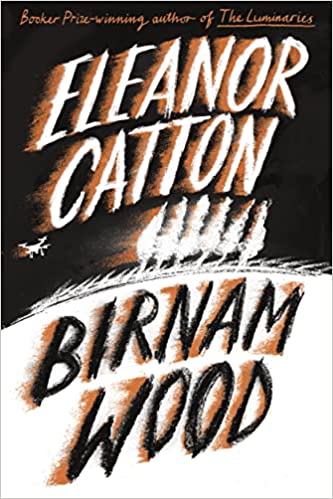
Birnam Wood, Eleanor Catton
You want to read this book because you want to combine your interest in the rise of a disconnected and sociopathic class of billionaires with your desire for high quality thriller fiction. On every level Birnam delivers, a plot-driven narrative that is both plausible and intensely readable. The basic premise is a super-rich investor buying a plot of land for a bunker, the land being protected by his drones and guards, alongside the interconnected story of a commune-like group of green ‘makers and doers’ looking for a new project. There the plot detail must end. What Catton does so brilliantly here is to build convincing and rounded characters, extending to the internal monologues of the wealthy protagonist who appears as manipulative and driven and to the concerned activists trying to read the intentions of malign actors around them. Like all good thrillers there are twists and big turns, it’s a rollicking read that is absolutely for our times.

The Future, Naomi Alderman
Achingly cool, with its bleeding-edge references to AI, tech culture and the inner life of the small coterie of world-influencing billionaires (a thinly veiled Musk, Bezos, and Zuckerberg, among others), The Future presents a story that hinges on the life of a super-smart, survivalist, lesbian hero, navigating the dangers of a world manipulated and made unstable by its powerful tech elite. This is a world that blurs because of its own radical uncertainties – nano AI drone bots protecting home lairs, protective phone systems that alert its privileged users of dangers that are gleaned from trawling global data streams. All of this is narrated by a high-speed stream of tech talk, deadpan drawled by the book’s, often unpleasant, characters. Something deeper is going on (as, of course, it must be), but the deeper layer of reality that emerges is incredibly satisfying and thought-provoking. If I discuss this with you at all the book’s core premise and delight will be ruined, and I will be airlifted out of my office by large AI-face recog drones triggered by my typing of the key plotlines on my laptop. The payoff is good and the ride is a lot of fun.

Jungle House, Julianne Pachico
If you are alarmed by where AI is going but cannot quite articulate your own fears of what may be possible, perhaps Jungle House will deliver clarity to you in spades. The book revolves around the hermetic life of a small residence in the remote jungle. This is a micro-world, a domestic space in the remote wilds, a home watched over by an AI security system, looking over her protegee, a young girl called Lena. Where and when they are is not clear, but the growing reveals of the nature of their universe delivers a satisfying sense of continued revelation. The themes being brought to our attention through this weird symbiosis are very human – trust, betrayal, care, complex relationships and the need for a reliable and predictable world. The AI concerns of the book are wrapped in the novel’s portrayal of how human actors are able to find a sense of place and sustenance that is delivered by both other human and non-human actors. The AI are sufficiently complex and human-like in their responses as to be accepted as knowing and relatable entities. Are these relationships in some sense authentic, or are they less than human or relatable because they exist between a box in the basement and a girl? We are probably not sure. Like Ishiguro’s ‘Klara and the Sun’ the effect is to raise significant questions about what matters or not in human and more complex sets of relationships and to realise that we, as readers, are ourselves feeling something for synthetic entities that appear to care for us. There is something quite brilliant about this short and original novel.
Buy these books at your local independent book store, not at Amazon or ABE books (which is owned by Amazon). Support providers who pay their taxes and play a role in your town.
 Alpha City